
Your car’s paintwork acts as a protective shield for its bodywork. But chips and scratches that expose the metal can be the catalyst for rust and corrosion, which, in turn, can cause extensive damage.
That’s why knowing how to fix rust on a car is a skill every owner needs. Here’s what you need to know about getting rid of rust and doing rust spot repairs on your vehicle.
Why is it important to get rid of rust on a car?
Let’s start with the science. Rust is the result of a chemical reaction known as oxidation. Key to this process is moisture, which can come from rain, snow, or water spray. The result? Even the smallest scratch can create an entry point for rust damage.
Surface rust is a relatively easy fix, but you’ll need to work fast. If you don’t tackle that chip, oxidation can take hold, and scale rust can start to form. Ignore that issue, and penetrating rust can set in. This could then corrode so severely that it becomes a safety-critical MOT fail.
To avoid getting rust spots, give your car a complete visual inspection. Check high-wear areas like door handles and sills, joins between panels, and the edges of your doors, bonnet, and boot. If you spot any telltale rust spots, take action immediately.
How to fix rust on your car
Most rust damage starts with something as simple as a minor ding or chip. So, if you do spot the telltale signs of surface rust, don’t panic. Knowing how to remove rust from a car could make the difference between a home repair and a costly trip to the bodyshop.
Tackling small rust spots is relatively easy, but preparation is key for the best results:
- Remove the loose rust: Remove any loose rust flakes with a wire brush or fine sandpaper. Keep working until you reach non-rusted metal, providing a clean base for your repair.
- Treat with a rust remover: Apply a rust remover or converter to the area with a brush, being careful not to get any on your paintwork. Look for products that neutralise and convert the rust into a stable surface for your repair. Leave the product to work its magic and reapply if necessary.
- Add filler: If the rust damage has left a hole or dent, you may need to use a filler to build up the surface. Apply according to the instructions, and sand level when it’s dry. Otherwise, you should have a clean surface ready for priming and painting.
- Apply primer: A primer provides a protective layer and helps improve paint adhesion. Check whether your rust-removing product also contains an inhibitor, as you may not need a primer.
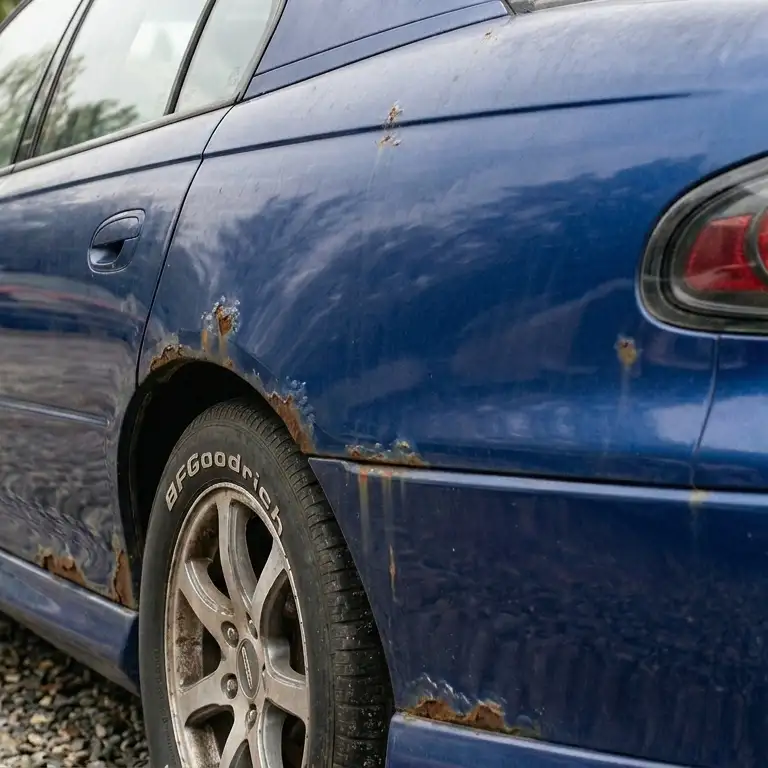
Can touch up paint cover rust?
Spotted bubbling paint and discolouration on your paintwork? Touch up paint is a great way to cover up rust, but it’s only a cosmetic fix. Painting over the damage will seal the area and prevent moisture from penetrating further, but it won’t stop the rust.
In fact, covering up the problem could make it worse, because you won’t see how far the rust has spread until it’s too late. Treating the rust first is essential before moving on to the next step: touching up your car’s paintwork to restore a like-new appearance.
How to safely apply touch up paint to a car affected by rust
Once you’ve prepared the surface, you’re ready to apply your car touch up paint. It’s imperative you find your car colour match for the perfect repair, and you can do this easily by selecting your make and model or inputting your registration into our handy car colour code finder.
The correct paint code lets us custom mix your precise colour, shade and finish for a seamless repair.
Once you’ve ordered your kit, here’s how to apply your paint and blend away the damage. Our Chipex™ Lite, Chipex™ Plus, and Chipex™ Pro kits are beginner-friendly and include everything you need to achieve professional-level results.
Step 1: Apply your paint
You’ll find everything you need in your Chipex™ Lite, Plus, or Pro kit, including protective gloves. Thanks to the all-in-one formula with a patented car lacquer included, you won’t need a separate clear coat for a long-lasting repair.
Apply the paint to the prepared area with the brush provided, then smear it across the repair until smooth. Make sure to wait until it’s touch-dry. This could take between 30 seconds and 5 minutes depending on ambient temperature.
Step 2: Use the blending solution
The key to making an invisible repair is to blend the new paint with your existing paintwork. Using our colour matching technology, you’ll get the perfect hue. Plus, our blending solution lets you feather the edges of the paint for a seamless repair.
Simply apply the solution to the paint-removing cloth and remove the excess. There’s no need to rub, since the solution will do the hard work for you. Leave to dry thoroughly before applying polish.
Step 3: Apply polish
Use the microfibre cloth to apply the polish over the entire area. Once it turns hazy, remove it with the microfibre cloth and buff to a shine. For best results, polish the entire panel.
Remember to work in a well-ventilated area, or outside, and always follow the instructions. We recommend you start with the smallest area first to get used to the simple three-step process.
Rust sorted? Order your Chipex™ touch up paint kit today
Rust damage can be frustrating, but knowing how to fix rust spots on a car and use our touch up paint to make your vehicle look as good as new couldn’t be easier with Chipex™. Our all-in-one solution also comes in three kit sizes to avoid waste and to suit your exact level of damage.
With our 100% colour matched guarantee, you can achieve durable, professional repairs even if you’ve never used touch up paint before. Ready to tackle rust spots and follow-up with advanced auto repair paint?
Order your Chipex™ touch up car paint repair kit today.


